
General Contractor Insurance in the San Fernando Valley: License Bonds, GL and Workers Comp

The paperwork side of running a contracting business in the San Fernando Valley never really ends. There is what the CSLB requires of you, there is the coverage your clients want to see before they sign anything, and there is the risk sitting on every active job site.
Then there is the part that catches most Valley contractors off guard. They assume they are covered until a claim gets filed and the gap shows itself. This walks through the three pieces every contractor here needs, license bond, general liability, and workers compensation, and how they fit together rather than sitting in three separate folders.
Why Valley Contractors Have Different Coverage Needs
The Valley is not one market. Residential and commercial work sit side by side in Tarzana, Woodland Hills, Northridge, and everywhere around them. One week is a kitchen remodel, the next is a strip mall buildout.
The risk profile shifts with it. Plenty of Valley jobs sit in or near wildfire zones, or involve older homes with dated wiring, plumbing, and materials. Open one of those walls and your exposure changes immediately.
General contractors and property owners are also asking for certificates of insurance more than they ever have. No certificate, no job. The practical takeaway is simple: real protection here is not one policy, it is three distinct pieces.
License Bonds Keep You Legal
A lot of contractors think of the bond as insurance. It is not. A bond is a financial guarantee made to the state and to your clients. If a valid claim is paid out on it, you are the one who repays it.
The CSLB requires an active $25,000 contractor license bond on file to keep a California contractor license. There are others you may run into: a bond of qualifying individual, used when someone other than the license owner qualifies the license, and a disciplinary bond, imposed after certain infractions. They are not interchangeable.
If your bond lapses, the CSLB suspends your license, and you cannot legally operate until it is reinstated. Because the bond is one part of a larger system, it is worth reviewing alongside your business insurance rather than on its own.
General Liability Protects You and Your Client
General liability insurance covers claims involving bodily injury or property damage, with limits and options you can shape around the kind of projects you take on in the Valley.
Plenty of Valley contractors get into trouble after the job wraps, because clients rarely wait long to raise a concern. Your crew scratches a client's hardwood floors. A visitor at a client's home trips over your equipment and sues. Without general liability, every one of those costs lands on you.
This is also why property owners and general contractors ask to be named as additional insured on your policy. General liability is what lets you meet that obligation and protects the owner and the GC from claims tied to your completed work.
Workers Comp Is Required the Moment You Have Employees
In California, workers compensation is not optional once you have employees on payroll. Going without it exposes you to penalties, stop work orders, and suspension of your contractor license.
Workers comp covers the medical bills and lost wages of an injured employee, which is a routine reality on construction sites. There is also the uninsured subcontractor trap: hire an uninsured sub, and if one of their employees gets hurt, that injury can land on you. Verify every subcontractor's coverage before they set foot on your site.
How the Three Pieces Work Together
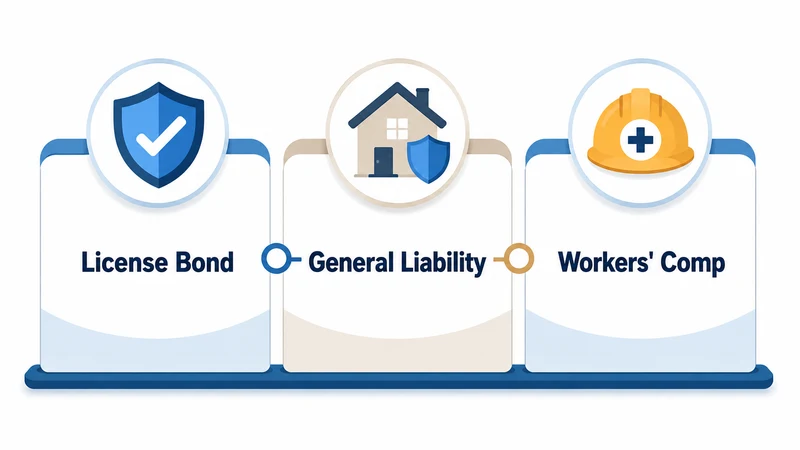
The clean way to think about it: your bond answers to the state, your general liability answers to your clients, and your workers comp answers to the law and your crew. Each one covers a requirement the others do not touch.
Bundling them under a single business insurance program is not just tidier. It makes renewals simpler and keeps your limits aligned, so you are not discovering a mismatch in the middle of a claim.
Add-Ons Valley Contractors Often Overlook
The three core pieces are the foundation. A few add-ons save real money and stress on top of them.
- Commercial auto. Your work trucks and the gear inside them are not covered by a personal auto policy once they are in service for the business. Commercial auto coverage closes that gap.
- Tools and equipment coverage. Protects you against theft or a break in, which is where most contractors take their first uninsured loss.
- Umbrella coverage. Worth having on high exposure residential projects in places like Calabasas, where a claim can exceed your standard limits.
- Builder's risk. Covers the project itself during ground up construction or a major renovation, while it is still being built.
How an Independent Agent Helps You Get It Right
An independent agent shops multiple A rated carriers instead of pushing one size fits all coverage, and shapes the policy around your trade and the kind of projects you actually take. Just as important, a good agent turns around certificates and additional insured requests quickly. A slow certificate loses jobs. Working with a local, licensed Valley team means the people handling it understand the market you work in.
The Bottom Line
The right combination of license bond, general liability, and workers compensation keeps you licensed, hireable, and protected. That is what a contracting business runs on. Do not let a claim be the thing that reveals your coverage gap.
Get Your Coverage Lined Up Before the Next Job
We write business insurance for Valley contractors across multiple A rated carriers, and we turn certificates around fast.
Tell us what you build and who you build it for, and we will put together coverage that fits how you actually work. Get in touch for a free quote.
Frequently Asked Questions
Do I need general liability to get a California contractor's license?
The CSLB requires a $25,000 license bond, not general liability, to hold the license itself. In practice, most clients and general contractors will not hire you without proof of general liability, so you need both to actually work.
Is workers comp required if I am a solo contractor with no employees?
Usually not, since California requires it of employers. The catch is that hiring an uninsured subcontractor can make that sub's injured employee your responsibility, so the exemption disappears faster than most solo contractors expect.
What happens if my contractor license bond lapses?
The CSLB suspends your license, and you cannot legally perform work until it is reinstated. Lapses are worth avoiding at all costs, because the downtime usually costs more than the bond itself.
Why do clients ask to be named additional insured?
It extends your general liability coverage to protect them for claims arising out of your work. Property owners and general contractors request it routinely, and most contracts will not move forward without it.
Can I put all of my contractor coverage under one policy?
Largely, yes. Placing your bond, general liability, and workers compensation with one agency simplifies renewals and makes proof of insurance requests much faster to fulfill.