
Life Insurance 101: Term vs. Whole Life for California Families

Buying life insurance ranks among the biggest money decisions a California household ever faces. Maybe you are raising kids in San Diego, closing on a first home in Sacramento, or running a small business somewhere in the Bay Area. Whatever your situation, the right policy stands between your loved ones and financial hardship if something happens to you.
Still, the choice trips a lot of people up. Two names come up again and again, term and whole life, and figuring out which one belongs in your budget can feel like decoding a foreign language. Let's fix that. Below, we walk through how these policies differ, how much protection your family actually needs, what shapes the price you pay, and when each option earns its place in your plan.
The Basics, Without the Jargon
At its core, life insurance is a promise. In exchange for the premiums you send in, the company commits to handing a death benefit to whomever you have listed, your beneficiaries, should you die while the plan remains active. That money can cover a lost paycheck, pay a mortgage, fund college, or pay funeral bills so the people left behind are not scrambling to cover them.
The two big categories go about that promise in very different ways, and knowing the difference is where every smart decision starts.
Term vs. Whole Life: What Actually Sets Them Apart
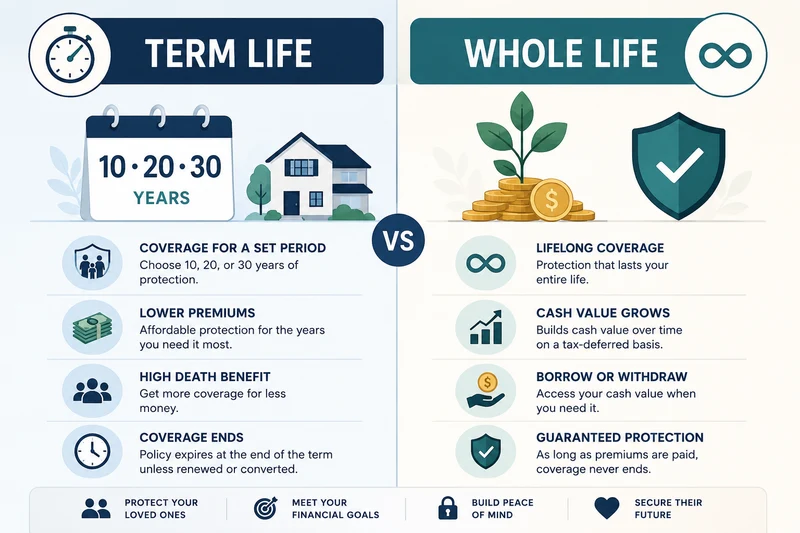
Term life protects you for a set number of years, commonly 10, 20, or 30. Pass away inside that window and your beneficiaries receive the payout. Make it to the end still living, and the plan quietly wraps up unless you choose to renew or convert. Nothing is set aside as savings, which is precisely what keeps this temporary route so light on the wallet. You are buying protection and nothing else.
Whole life, by contrast, sticks around permanently. Keep the payments current and the plan stays with you for good. On top of that, it accumulates cash value, an internal savings piece that climbs each year without being taxed as it grows. That pot of money is something you can borrow against, and sometimes withdraw from outright. Since a lifelong plan pairs protection with that expanding account, you will pay noticeably more than you would for an equivalent term option.
Here is a simple way to frame it: term hands you a sizable death benefit for a limited period at a friendlier price, while permanent coverage secures protection for life alongside a savings feature that carries a higher cost. There is no universal winner here. What suits you comes down to where you are headed, how long you need the coverage, and the payment you can live with month to month.
Figuring Out How Much Coverage You Need
Before you compare policy types, nail down the number. Guess too low and your family comes up short. Guess too high and you are overpaying for a financial safeguard you do not need.
A few things to weigh when you run the math:
- Replacing your income. Start with what you earn in a year, then stretch it across however long your household would depend on those dollars, frequently right up until the children are self-sufficient or a partner reaches retirement age.
- Debts you would leave behind. Add up the mortgage, car loans, credit cards, and anything you have co-signed. In California, where home prices run high, the mortgage is usually the heaviest line item by far.
- Future goals. Factor in college tuition, childcare, and other long-term financial obligations you want funded.
- Final expenses. Set aside room for funeral costs and settling your estate.
- What you already have. Knock off whatever you have stashed away: savings, investments, and any workplace group plan already in your name.
A figure people toss around is roughly 10 to 15 times what you make in a year. Treat that as a launch pad rather than gospel. The number you land on ought to reflect the real bills and way of life your family carries. A conversation with a licensed advisor is the most reliable way to fine-tune it.
What Drives the Price You Pay
Two people can buy the same policy and pay wildly different premiums. Insurers set your rate through underwriting, the process of sizing up how much risk you bring. Several things move the needle:
- Age. Buy earlier and you will spend less. No other factor pulls harder on your rate than this one.
- Health history. Chronic conditions, family medical history, and results from your medical exam all factor in. Some no-exam policies skip the physical but often cost more.
- Tobacco use. Smokers pay noticeably more than non-smokers.
- Occupation and hobbies. High-risk jobs or pastimes like skydiving can push rates up.
- Coverage amount and term length. A larger payout or a longer stretch of coverage naturally raises the price.
Understanding these levers helps you see why locking in a policy while you are young and healthy pays off, and why insurability tends to get pricier, not cheaper, as the years pass.
How Cost Shifts by Age
Age shapes premiums more than almost anything else, so it is worth seeing how the two options stack up across life stages.
Your 20s and 30s
This is the sweet spot. Term coverage is remarkably cheap for young families who need a big payout during their prime earning and child-raising years. Permanent life costs more, but starting early means smaller lifetime premiums and more runway for cash value to grow.
Your 40s
Rates edge up and health starts to matter more. Term remains a smart, budget-friendly way to cover a mortgage and children still under your roof. Plenty of families begin mixing strategies here: a term policy for the temporary stuff, plus a smaller permanent policy aimed at long-term goals.
Your 50s and beyond
Prices climb further. Term is still on the table but for shorter windows and higher premiums. Lifelong coverage grows appealing for folks focused on estate planning, dodging probate headaches, or leaving a guaranteed legacy. Since this is the priciest stage to buy in, acting sooner almost always saves money.
Across every age bracket, term wins on affordability for pure protection, while permanent policies charge more in exchange for coverage that never expires and a cash balance that keeps building.
When Term Life Is the Right Call
A term policy usually makes the most sense when you:
- Want the biggest possible death benefit for the smallest premium.
- Have a clear time frame, such as the years until the mortgage is paid or the kids finish school.
- Have limited room in the budget yet want the fullest protection for your family today.
- Would rather invest the money you save on premiums somewhere else, like a retirement account.
For most young, growing California families, term coverage delivers strong income protection during the exact years when financial pressure runs highest.
When Whole Life Earns Its Keep
Permanent coverage tends to fit better when you:
- Want protection that lasts your whole life, not just a set number of years.
- Like the idea of tax-deferred cash value you can borrow against down the road.
- Are thinking about estate taxes, a trust, or leaving a guaranteed inheritance.
- Have already filled up your other tax-advantaged accounts and are hunting for one more long-term option.
- Prefer level premiums that stay put instead of climbing as you age.
Families with wealth-transfer goals or a strong desire for guaranteed, lifelong coverage often find this route lines up neatly with their plans. Owners of a small business also lean on permanent coverage to fund buy-sell agreements and keep the company steady if a partner dies.
A Look at Common Riders
Riders are optional add-ons that customize a policy to your life. A few worth knowing:
- Accelerated death benefit. Allows you to draw on a portion of the payout ahead of time if a doctor confirms a qualifying terminal diagnosis.
- Waiver of premium. Keeps the plan running even when you stop paying, provided a disability leaves you unable to work.
- Child rider. Folds a modest layer of protection for your kids into the same policy.
- Critical illness rider. Delivers a one-time sum should you receive a diagnosis for one of the covered serious conditions.
These living benefits can turn a basic policy into a far more flexible safety net.
Mistakes California Families Make
Even well-meaning buyers slip up. Watch out for these:
- Waiting too long. Every birthday nudges your premium higher and can complicate insurability.
- Buying too little. A number that felt fine years ago may not stretch over today's mortgage and living costs.
- Leaning only on work coverage. Employer group plans rarely cover enough and usually vanish when you change jobs.
- Forgetting beneficiary updates. Marriage, divorce, and new kids all call for a fresh beneficiary designation.
- Ignoring inflation. A fixed death benefit buys less over time, so revisit your protection every few years.
Why Mixing Both Often Works Best
Lots of California families do not pick a single lane. A popular move pairs a large term policy for the high-need years with a smaller permanent policy for lifelong peace of mind. You keep costs reasonable while covering both today's obligations and tomorrow's goals. A licensed advisor can help you build a blend that fits your budget and priorities, and California insurance rules make sure any policy you buy meets state consumer-protection standards.
Choose Online General Insurance for Your Family's Protection
Sorting out term versus whole life gets a whole lot easier with an experienced partner in your corner. At Online General Insurance, we help California families weigh their options in plain English, land on the right coverage amount, and build a policy that respects both their budget and their goals.
Our licensed advisors take the time to learn your story and walk you through every choice, never a one-size-fits-all answer. Explore our life insurance services or talk to our team and get a free quote today.
Frequently Asked Questions
Can I convert a term policy to permanent coverage later?
In many cases, you can. A good number of term plans carry a conversion privilege, giving you the option to move into a lifelong policy without going through another medical exam, typically if you act inside a defined timeframe. That kind of flexibility comes in handy when your circumstances change.
Does life insurance cost more in California?
What you pay is driven mainly by your age, health, how much coverage you choose, and how you live, not by the zip code on your mailbox. Even so, the steep home prices and cost of living across California often push families here toward larger death benefits.
What happens to my term policy if I outlive it?
The plan just runs out. From there you can renew it, convert it, or shop for a brand-new one, though the rate will be tied to whatever age you have reached by then.
Is the cash value in a permanent policy really mine?
Yes. It belongs to you and grows over time. You can borrow or withdraw against it, though unpaid loans can shrink the death benefit.
Is my employer's group life insurance enough?
Rarely. Coverage through work is usually on the small side, and it walks out the door with you the moment you change jobs, which is why most families add a policy of their own on top of it.
Can a stay-at-home parent benefit from life insurance?
Without a doubt. Everything a stay-at-home parent handles, from raising the kids to keeping the household running, has a genuine dollar value that a family would have to pay someone else to cover, which makes a policy well worth a look.
What happens if I miss a premium payment?
Nearly every policy gives you a grace period to make things right. Let that window slip by, though, and the coverage can lapse, so it is smart to schedule reminders or turn on automatic payments to keep your protection intact.