
What Does a Venue Need on a Certificate of Insurance (COI) for an Event in California?

You have booked the venue, coordinated the vendors, and started working through the final details of your event. Then the venue asks for a certificate of insurance (COI) before the event date.
What exactly are they asking for?
For many weddings, receptions, private parties, corporate gatherings, and other special events in California, a venue may require proof that the organizer has appropriate event liability insurance. A certificate of insurance is commonly used to provide that proof.
But simply sending any insurance document may not be enough. The certificate may need to reflect the correct insured name, event information, coverage dates, liability limits, and other details requested by the venue. In some cases, the venue may also require additional insured status.
Understanding the requirements before purchasing coverage can help you avoid last minute certificate corrections and delays.
If your California venue has already provided insurance requirements, Online General Insurance can help you review wedding and event insurance options and determine what documentation may be available for your event.
What Is an Event Insurance Certificate of Insurance?
A certificate of insurance for an event is a document that provides evidence of insurance coverage in effect at the time the certificate is issued.
For an event organizer, it may be used to show a venue, property owner, event facility, or another interested party that applicable liability coverage has been obtained.
The COI generally summarizes important policy information, such as:
- Name of the insured
- Insurance carrier
- Policy number
- Type of coverage
- Policy effective and expiration dates
- Coverage limits
- Certificate holder information
A COI is evidence of coverage; it is not the insurance policy itself and does not independently change the policy's terms or create coverage that the policy does not provide.
That distinction matters. Event organizers should not assume that receiving a certificate means every possible event related loss is covered. Actual protection is determined by the policy's terms, conditions, limits, endorsements, and exclusions.
Why Would a California Event Venue Ask for a COI?
Venues host groups of people on property they own, lease, or manage. Weddings and other events can introduce potential risks ranging from a guest slipping and being injured to accidental damage to venue property.
A venue may therefore make proof of liability insurance part of its rental agreement.
For example, imagine that you are hosting a wedding reception and a guest accidentally damages part of the rented property. Or someone is injured during the event and a liability claim follows.
Event liability coverage is designed to address certain covered liability exposures, subject to the policy's terms.
A venue's COI request allows it to confirm that the insurance documentation provided for the event reflects the coverage information it requested.
Not every venue uses identical requirements, however. Your contract or the venue's insurance instructions should be the starting point.

What Information Does a Venue Typically Look for on an Event Insurance COI?
The exact requirements depend on the venue and policy, but several pieces of information are commonly important.
1. Correct Name of the Insured
The certificate should accurately identify the person or entity insured under the applicable policy.If you are purchasing coverage for a wedding, private celebration, business gathering, or another event, make sure the information submitted for the policy is accurate.Small discrepancies can matter when a venue is comparing the certificate with its rental agreement.
2. Correct Event Date and Coverage Period
The coverage dates shown on the certificate need to align with the applicable policy and the venue's requirements.Do not assume the ceremony or party's start time is the only period that matters. A venue's contract may contain specific insurance requirements related to the event.Review those instructions before finalizing coverage rather than trying to correct the documentation immediately before the event.
3. Appropriate Liability Coverage
A venue may ask for proof of event liability coverage because of potential bodily injury or property damage claims associated with the event.The amount of coverage requested can vary.Instead of selecting a limit based on what another couple, event organizer, or venue required, check your own contract.If you need help understanding available event liability options, review OGI's Wedding & Event Insurance coverage.
4. Venue Listed Correctly as the Certificate Holder
The venue may provide the exact legal name and address it wants shown on the certificate.Use the wording supplied by the venue.The name customers commonly use for a venue may differ from the legal entity identified in its insurance instructions. Copying the requested information carefully can reduce unnecessary revisions.
5. Additional Insured Information, When Required
This is one of the most important areas to understand.Being listed as a certificate holder is not necessarily the same thing as being an additional insured.The certificate holder receives evidence of insurance. Additional insured status, when provided, relates to rights under the applicable policy or endorsement and is subject to its terms.If your venue requires additional insured status, tell the insurance professional handling your event coverage. Do not assume that entering the venue's name in the certificate holder section automatically satisfies that requirement.
6. Policy and Carrier Information
The COI generally includes identifying information about the applicable policy and insurer.This helps the venue verify that the certificate corresponds to actual insurance coverage rather than being an informal confirmation from the event organizer.
7. Any Other Venue Specific Requirements
Some venues provide detailed insurance instructions with the rental agreement.Rather than guessing what belongs on the certificate, send those requirements to your insurance agent or producer.This can be especially helpful when the venue provides exact wording or identifies specific parties that need to appear in the insurance documentation.
Certificate Holder vs. Additional Insured: What's the Difference?
These terms are often confused during event planning.
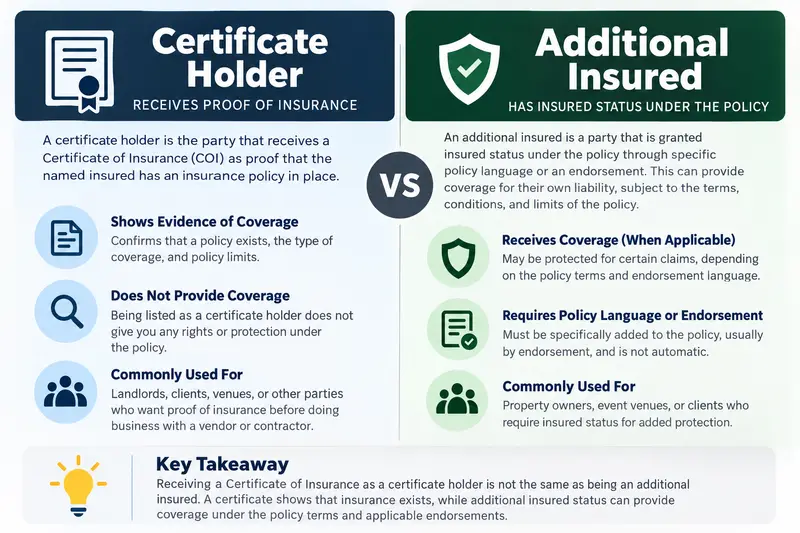
A certificate holder is generally the party receiving the certificate as evidence that insurance exists.
An additional insured, by contrast, is a person or organization that has been added to the applicable policy as an insured for specified coverage, typically through policy terms or an endorsement.
That means placing a venue's name on a COI as the certificate holder does not, by itself, necessarily make that venue an additional insured.
If your venue contract specifically says something such as "additional insured required," do not overlook the wording.
Send the requirement to your insurance professional so the appropriate policy and endorsement requirements can be reviewed.
Is a COI the Same as Event Insurance?
No.
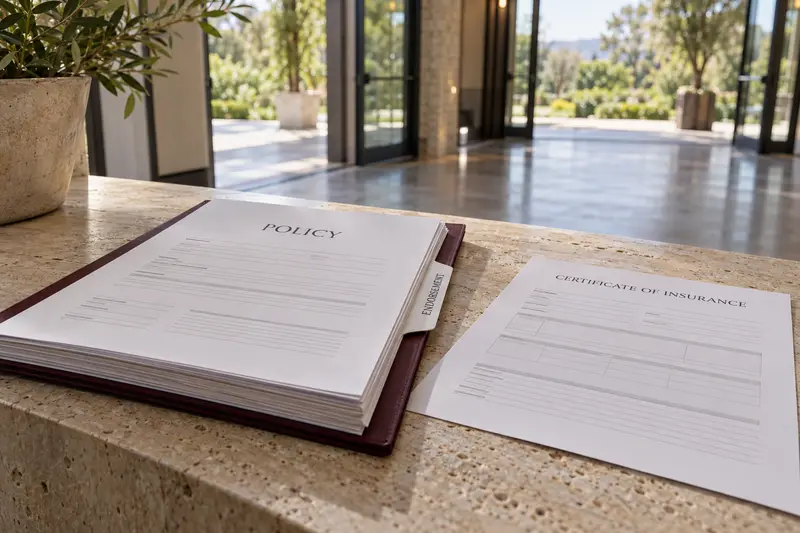
The insurance policy provides the actual coverage. The event insurance certificate provides evidence and a summary of certain policy information.
Think of the COI as documentation of coverage rather than the coverage itself.
This is also why choosing event insurance based only on whether you can obtain a certificate is not ideal. You should understand the underlying protection you are purchasing.
Depending on the policy selected, wedding and special event insurance may provide options related to event liability and other event specific risks. Available protection varies by insurer and policy.
You can learn more about wedding and event insurance in California before requesting a quote.
What Should You Ask the Venue Before Requesting Your COI?
Before purchasing coverage or requesting a certificate, ask the venue for its insurance requirements in writing.
Ideally, you want to know:
- The exact legal name to use
- The address that should appear on the certificate
- Whether the venue must be a certificate holder
- Whether additional insured status is required
- What liability limits the venue requires
- Whether any specific endorsements are requested
- The deadline for submitting proof of insurance
- Whether other parties must also be included
If the venue gives you an insurance requirements document, send the actual document to your insurance professional instead of paraphrasing it. One missed phrase can result in another round of revisions.
A Simple COI Checklist for California Event Organizers
Before sending your certificate to the venue, compare it against the venue's written requirements. Check that:
- 1 Your information is accurate. Verify the insured name and other identifying information.
- 2 The applicable dates are correct. Make sure they correspond with your event and policy.
- 3 The venue's information matches its instructions. Pay particular attention to the legal name and address.
- 4 The requested liability limits are reflected correctly. Compare the certificate with the venue's requirements.
- 5 Additional insured requirements have been addressed when applicable. Remember that certificate holder status alone is not necessarily additional insured status.
- 6 You have submitted it by the venue's deadline. Do not leave the insurance documentation until the final days of event planning.
Common COI Mistakes That Can Delay Venue Approval
Most event organizers do not deal with certificates of insurance regularly. A few avoidable issues can therefore create unnecessary back and forth.
Using the Venue's Informal Name
A venue's public facing name may not be the legal entity identified in its contract.Use the information the venue provides.
Assuming Certificate Holder Means Additional Insured
These terms serve different purposes. If additional insured status is required, it needs to be addressed properly under the policy.
Choosing Coverage Before Reading the Venue Contract
You may purchase a policy and then discover that the venue has requirements you did not consider.Getting the venue's requirements first can make the process easier.
Waiting Until the Last Minute
If the venue reviews your COI and requests a correction, waiting until the day before the event creates unnecessary pressure.Handle insurance documentation as part of your planning process rather than as a final administrative task.
Assuming the COI Expands Coverage
A certificate summarizes information about coverage. It does not replace the policy or override its terms.Always review the actual policy documents if you need to understand what is and is not covered.
What If Your Venue Rejects the Certificate?
A rejected COI does not automatically mean you have no insurance.
Sometimes the issue is administrative. For example, the venue name may need correction, or the venue may be asking for documentation that was not reflected as expected.
If a venue rejects your certificate:
- Ask why it was rejected.
- Request the required wording or documentation in writing.
- Send the venue's response to your insurance agent or producer.
- Allow the insurance professional to determine whether the request can be satisfied under the policy.
- Return the revised or additional documentation to the venue when appropriate.
Avoid manually altering an insurance certificate yourself. Certificate information should come through the appropriate insurance channel.
Do All California Venues Have the Same COI Requirements?
No.
There is no single venue checklist that you should assume applies to every California event.
A wedding venue in Los Angeles may have different contractual insurance requirements from a private event space elsewhere in California. Requirements can also differ based on the type of event, activities involved, venue policies, and other risk factors.
That is why your venue contract is more useful than a generic example found online.
For a separate discussion of what to review before signing a venue contract, our guide to California event venue insurance requirements covers the topic in greater detail.
Need a Certificate of Insurance for Your California Event?
When a venue asks for proof of insurance, you do not want to spend days trying to determine what policy to purchase or whether the documentation meets the venue's request.
Online General Insurance is a California licensed, family run independent insurance agency based in Tarzana and serving customers throughout California. The agency works with multiple insurance markets and offers wedding and event insurance options, including assistance with certificates of insurance where applicable.
If your venue has already sent you its insurance requirements, have them ready when you request coverage. That gives the agent clearer information to review from the beginning.
Planning a wedding or special event in California? Get a wedding and event insurance quote from Online General Insurance or call (818) 922-7225 to discuss your event and venue requirements.
Frequently Asked Questions About Event Insurance COIs in California
What is a COI for an event?
A certificate of insurance, or COI, is a document that provides evidence of insurance coverage and summarizes certain policy information. Event venues may request one to verify that an organizer has applicable liability coverage.
Why does my wedding venue need a certificate of insurance?
A venue may require a COI as part of its rental agreement to verify that required event liability insurance has been obtained. The exact requirement depends on the venue and contract.
Does listing a venue as a certificate holder make it an additional insured?
Not necessarily. Certificate holder status and additional insured status are different. If your venue requires additional insured status, provide that requirement to your insurance professional for review.
What information do I need from my venue for a COI?
Ask for the venue's exact legal name, address, required coverage limits, certificate holder instructions, additional insured requirements if applicable, and its deadline for receiving the certificate.
Can I get a COI before my California event?
A certificate may be available after appropriate coverage has been arranged, subject to the insurer and policy. It is better to address the venue's requirements early enough to allow time for any necessary corrections.
What if the information on my COI is wrong?
Contact the insurance professional who issued or arranged the certificate and provide the correct information. Do not alter the certificate yourself.
Is an event insurance COI proof that everything at my event is covered?
No. A COI provides evidence and summarizes certain insurance information. Actual coverage is governed by the policy, including its terms, limits, conditions, endorsements, and exclusions.