
Does Your California Event Venue Require Insurance? What to Check Before You Book

You find a California venue that seems perfect for your wedding, birthday celebration, corporate gathering, anniversary, or other special event. The date is available, the space works, and you are ready to sign the contract.
Then you notice a section about event liability insurance.
Does the venue actually require you to buy insurance? How much coverage does it expect? Does the venue need to be listed on the policy? And what happens if you sign the contract before checking these requirements?
Insurance requirements can vary from one venue to another. Some California venues may require event organizers to provide proof of liability coverage before the event, while the specific limits, documentation, and other conditions depend on the venue's contract.
The safest approach is simple: review the venue's insurance requirements before you finalize your booking and purchase coverage based on the actual requirements, not assumptions.
If a venue has already provided its insurance instructions, Online General Insurance can help you explore wedding and event insurance for your California event.
Why Do Event Venues Require Insurance?
Hosting an event creates exposures that do not exist when a property is empty.
Guests may be injured. Property can accidentally be damaged. Vendors may be moving equipment through the venue. Food and beverages may be served. Alcohol may be available. Temporary decorations, entertainment, or equipment may also introduce additional considerations.
A venue may therefore require the person or organization renting the property to carry event liability insurance.
Consider a simple example. During a wedding reception, a guest slips and is injured. In another situation, an attendee accidentally damages property belonging to the venue. Those incidents could potentially result in liability claims.
Event liability insurance can provide protection for certain covered bodily injury or property damage claims, subject to the policy's terms, conditions, limits, and exclusions.
For the venue, requiring proof of insurance can be part of its risk management process. For the event organizer, appropriate insurance can provide financial protection against certain unexpected covered incidents.
Is Event Insurance Legally Required for Every California Venue?
Not every event or venue operates under identical insurance requirements.
What matters most to you as the person booking the venue is what your particular venue requires under its contract and what coverage is appropriate for your event.
A private wedding venue may have one set of requirements. A banquet hall, corporate event space, community facility, or other property may use another.
Even two similar venues can have different:
- Liability limit requirements
- Certificate requirements
- Additional insured instructions
- Alcohol related requirements
- Documentation deadlines
- Rules for vendors
- Contract conditions
Do not assume that because your friend's wedding venue accepted one type of policy, your venue will do the same.Get the requirements directly from your venue.
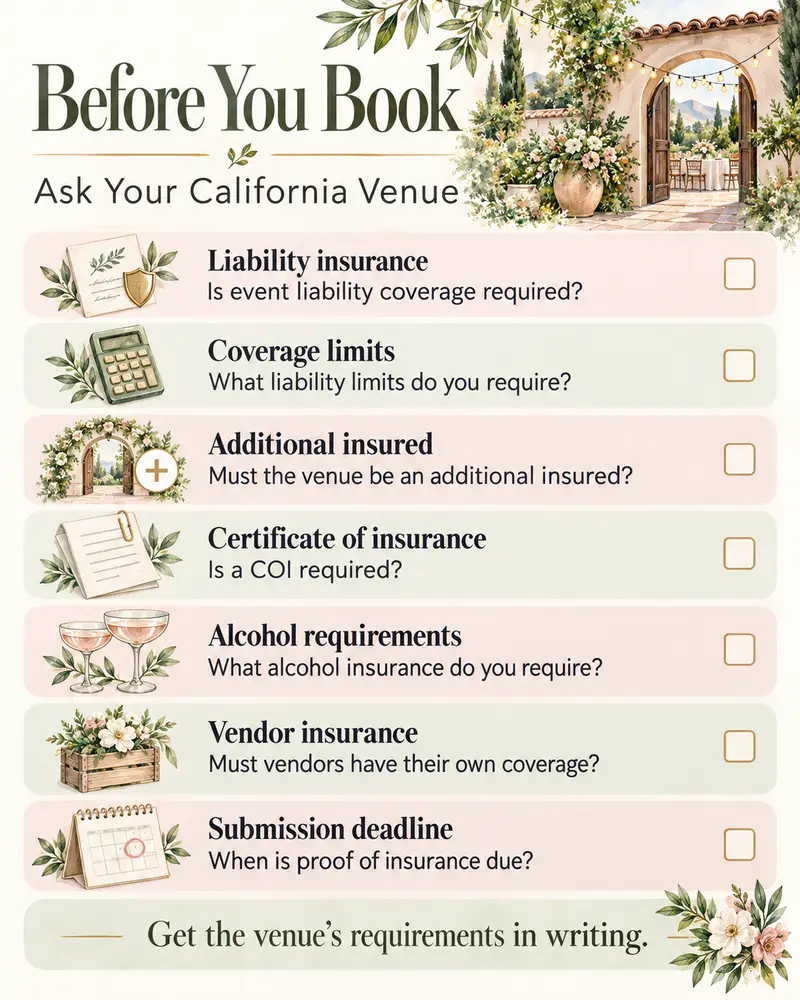
7 Insurance Questions to Ask Before Booking a California Event Venue
Insurance should be part of your venue checklist, not something you discover a week before the event. Before signing your rental agreement, ask these questions.
1. Does the Venue Require Event Liability Insurance?
Start with the most basic question.Ask the venue whether event liability insurance is mandatory under its rental agreement. If the answer is yes, ask the venue to send the requirements in writing.Written instructions are much easier to share with an insurance agent and reduce the risk of misunderstanding what the venue expects.
2. What Liability Limit Does the Venue Require?
Do not guess at the amount of coverage.Your venue may specify a minimum liability limit in its contract or insurance instructions. The required amount can depend on the venue and circumstances of the event.Before purchasing a policy, provide the requirement to your insurance professional and discuss available coverage.This question also deserves more detail than can reasonably fit here. Our guide on how much event liability coverage you need for a California venue explains coverage limits and how to evaluate them.
3. Does the Venue Need to Be an Additional Insured?
This is an important contractual detail.A venue may require that it be added as an additional insured under applicable event liability coverage. Do not confuse this with simply listing the venue as a certificate holder. Additional insured status and certificate holder status are not necessarily the same thing.If your contract says the venue must be an additional insured, provide the exact requirement to the insurance professional arranging your coverage.
4. Does the Venue Require a Certificate of Insurance?
A venue may ask for a certificate of insurance (COI) as evidence that applicable coverage is in place.The certificate generally summarizes certain policy information, such as the insured, insurer, policy dates, coverage and limits. The venue may also provide exact instructions about how its name and address should appear.If your venue has requested one, read our complete guide to what a venue needs on a certificate of insurance for a California event.
5. Are There Additional Requirements If Alcohol Is Served?
Do not overlook alcohol when discussing insurance with your venue and insurance professional.A reception, birthday party, company gathering, or other celebration may include beer, wine, cocktails, or another form of alcohol service. The insurance considerations can depend on how alcohol is being provided and the terms of the policy.Ask the venue whether it has specific alcohol related insurance requirements and tell your insurance professional how alcohol will be handled at the event.A separate guide in this series covers event insurance and host liquor liability in California in greater depth.
6. Are Vendors Required to Carry Their Own Insurance?
Your event policy and your vendors' insurance are not necessarily interchangeable.A venue may have separate insurance requirements for caterers, bartenders, rental companies, entertainers, photographers, production companies, or other vendors working on the property.Ask: “Do you require each vendor to provide separate proof of insurance?” If so, communicate that requirement to your vendors early.Waiting until the final week can create unnecessary problems if a vendor cannot provide what the venue requests.
7. When Is Proof of Insurance Due?
A venue may require insurance documentation before the event date.Find out the deadline while you are reviewing the contract. That gives you enough time to arrange appropriate coverage, submit the documentation, and address questions or corrections if the venue requests them.
What Event Liability Insurance May Cover
Event liability coverage is designed to address certain liability exposures associated with an event, subject to the particular policy.
Depending on the policy, coverage may address certain claims involving bodily injury or property damage.
For example, imagine that a guest trips over an object at your reception and is injured. Or suppose accidental damage occurs to property during a covered event. These are the kinds of situations that help explain why venues often pay close attention to liability insurance.
However, event insurance is not unlimited protection against everything that could go wrong.
Policies have terms, conditions, exclusions, and coverage limits. Always review the actual policy rather than assuming that a particular incident will automatically be covered.
For information about available options, visit Online General Insurance's Wedding & Event Insurance service page.
Venue Insurance Requirements vs. Your Own Coverage Needs
There is another distinction worth making.
Meeting your venue's minimum requirement does not automatically answer every question about what protection is appropriate for your event.
The venue's contract focuses on what the venue requires from you. Your insurance decision should also consider the nature of your event and available policy options.
A small private gathering may present different considerations from a large wedding reception or corporate event involving numerous guests and vendors.
When discussing coverage with an insurance professional, provide accurate information about the event rather than focusing solely on obtaining a document that satisfies the venue.
Read the Venue Contract Before You Pay the Deposit
It is easy to focus on the exciting parts of venue selection: capacity, photography locations, catering, parking, décor, views, and availability.
The contract deserves just as much attention. Before paying a nonrefundable deposit, look for sections labeled:
- Insurance
- Liability
- Indemnification
- Additional insured
- Certificate of insurance
- Alcohol
- Vendors
- Damage
- Cancellation
You do not need to interpret complicated insurance wording yourself. If something is unclear, ask the venue to explain its requirements and provide the relevant insurance language to your insurance professional.The goal is to identify requirements before they become a deadline problem.

What Information Should You Send to Your Insurance Agent?
Once you know what the venue requires, gather the relevant event information. Your insurance professional may need details such as:
- Type of event
- Event date
- Venue
- Expected attendance
- Venue's written insurance requirements
- Requested liability limits
- Additional insured instructions
- Whether alcohol will be served
- Other relevant event activities or exposures
Answer questions accurately. An insurance professional can provide better guidance when they understand the event rather than receiving only a request for “a COI.”
What If the Venue Says “$1 Million Liability Insurance Required”?
Treat that as a starting point, not the entire instruction.
Ask whether the venue also requires:
- Additional insured status
- A certificate of insurance
- Specific certificate holder wording
- Particular endorsements
- Alcohol related coverage
- Insurance from individual vendors
- Documentation by a particular deadline
A single sentence about a liability limit may not represent every insurance provision in the rental agreement. Send the full requirement to your agent whenever possible.
What If the Venue Doesn't Require Event Insurance?
If a venue does not make insurance mandatory, that does not necessarily mean there are no event related financial risks.
Accidents, property damage, cancellations, vendor problems, and other unexpected situations can still occur.
Available wedding and special event policies may offer different types of protection depending on the insurer and policy selected.
Rather than treating insurance solely as a venue requirement, consider whether available coverage makes sense for the financial risks associated with your event.
What About Wedding Cancellation and Vendor Problems?
Liability is only one area of potential event risk.
Weddings in particular can involve significant advance payments to venues, caterers, photographers, entertainment providers, rental companies, and other vendors.
Depending on the insurance purchased, separate event related coverage may be available for certain cancellation or vendor related losses. The exact protection depends on the policy and circumstances.
If protecting wedding expenses is important to you, discuss those concerns specifically when exploring wedding and event insurance.
Our upcoming guide on wedding vendor cancellation insurance will look more closely at what may happen when a vendor cancels and how applicable event insurance may respond.
Don't Forget to Ask About Alcohol
Alcohol deserves special attention because the insurance implications can differ depending on the circumstances.
Tell your insurance professional:
- Whether alcohol will be available
- Whether it is being sold or provided
- Whether a bartender or caterer is serving it
- What the venue requires
Do not assume general event liability automatically addresses every alcohol related exposure.Our dedicated guide, “Does Event Insurance Cover Alcohol? Understanding Host Liquor Liability in California,” will explain this topic separately so the distinction remains clear.
How Early Should You Handle Venue Insurance Requirements?
Do not wait until the week of the event.
Ideally, you should identify insurance requirements while evaluating the venue contract. Once you have booked the venue, keep its insurance deadline in your planning calendar.
Handling coverage early gives you time to:
- Obtain the venue's requirements.
- Discuss available insurance options.
- Arrange appropriate coverage.
- Request required documentation.
- Submit it to the venue.
- Correct documentation if necessary.
For a detailed planning schedule, see our upcoming guide on when to buy event insurance for California weddings and special events.
California Event Venue Insurance Checklist
Before signing your venue contract, confirm the following:
- Does the venue require event liability insurance?
- What liability limit does it require?
- Does it require additional insured status?
- Does it require a certificate of insurance?
- What exact venue name and address should be used?
- Are there special requirements involving alcohol?
- Do individual vendors need their own insurance?
- When is proof of insurance due?
- Are there other insurance provisions in the contract?
- Have you provided the requirements to your insurance professional?
Keeping these answers with your venue documents can make the insurance process much easier later.
Common Mistakes to Avoid
Assuming Every California Venue Has the Same Requirements
They do not. Follow your venue's actual written requirements.
Buying Coverage Before Reading the Contract
You may later discover that the venue expects different limits or documentation.
Treating a COI as the Insurance Policy
A certificate is evidence of insurance. The underlying policy determines actual coverage.
Confusing Certificate Holder With Additional Insured
These terms should not automatically be treated as interchangeable.
Ignoring Alcohol Requirements
If alcohol will be present, disclose it and determine what the venue and policy require.
Forgetting About Vendors
Your venue may expect certain vendors to carry their own insurance.
Waiting Until the Last Minute
Venue approval can become stressful when insurance documentation is left until just before the event.
Planning an Event in California? Review the Insurance Requirements Early
Venue insurance requirements do not need to become another stressful part of event planning. The key is to identify them early.
Before signing, or as soon as possible after booking, get the venue's requirements in writing. Review the liability limits, certificate instructions, additional insured requirements, vendor rules, alcohol provisions, and submission deadline. Then provide those requirements to an insurance professional who can help you explore appropriate coverage.
Online General Insurance is a California licensed independent insurance agency based in Tarzana, serving customers throughout California. Its insurance offerings include wedding and special event coverage, and the agency can assist with certificates of insurance where applicable.
Already have the venue's insurance requirements? Request a wedding and event insurance quote from Online General Insurance or call (818) 922-7225 to discuss your California event.
Frequently Asked Questions About California Event Venue Insurance
Do event venues in California require liability insurance?
Requirements vary by venue and rental agreement. Some venues require event organizers to obtain liability insurance and provide proof before the event. Review your specific venue contract rather than assuming the requirements.
How do I know how much insurance my venue requires?
Check the insurance section of the venue contract or ask the venue for its requirements in writing. If a minimum liability limit is specified, provide that information to your insurance professional.
Why does my venue want to be an additional insured?
Some venues require additional insured status as part of their contractual risk management requirements. Whether and how this can be provided depends on the applicable policy and endorsement.
What proof of insurance does an event venue need?
A venue may request a certificate of insurance showing applicable policy information. Requirements vary, so follow the venue's written instructions. Read our California event insurance COI guide for a more detailed explanation.
Do my wedding vendors need their own liability insurance?
Possibly. Some venues impose separate insurance requirements on vendors working at the property. Ask the venue and communicate those requirements to your vendors well before the event.
Does a venue insurance requirement include alcohol liability?
Not automatically. Alcohol related requirements depend on the venue, event, circumstances, and policy. Tell your venue and insurance professional how alcohol will be handled.
Should I get event insurance before booking a venue?
At minimum, review the venue's insurance requirements before finalizing the contract so you understand what will be expected. The appropriate timing for purchasing coverage depends on your circumstances and available policy terms.