
How Much Event Liability Coverage Do You Need for a California Venue?

Your California wedding or special event venue says you need liability insurance before the event.
The next question is usually: How much event liability coverage do I need?
You may see a required limit in your venue contract. You may also encounter different coverage options while shopping for event insurance. Choosing a limit should not come down to picking the cheapest option or copying what someone else purchased for their wedding.
Start with your venue's written insurance requirements. Then consider the size and nature of your event, what activities are planned, whether alcohol will be present, and the coverage options available under the policy.
There is no single liability limit that should automatically be treated as right for every California event.
If you already have your venue's insurance requirements, Online General Insurance can help you explore wedding and event insurance options and available coverage for your event.
What Is Event Liability Insurance?
Event liability insurance is designed to provide protection against certain third party liability claims arising from a covered event, subject to the policy's terms, conditions, exclusions, and limits.
Two important areas commonly associated with liability coverage are:
- Bodily injury, such as certain situations where a guest or another person is injured during the event.
- Property damage, such as certain situations involving accidental damage to property for which the insured may be legally liable.
For example, imagine a guest is injured in an accident during a wedding reception and a covered liability claim results. Or suppose accidental damage occurs to venue property during a covered event.The financial consequences of liability claims help explain why many venues pay close attention to insurance before allowing an event to take place.Event liability insurance does not mean every accident or loss will be covered. The actual policy determines the scope of coverage.
How Much Event Liability Coverage Do I Need?
There isn't one universal answer.
A practical starting point is to answer two questions:
- What liability limit does my venue require?
- What amount of coverage is appropriate for my particular event and available under the policy?
If the venue contract specifies a minimum amount of liability insurance, you need to know that requirement before purchasing coverage. However, the venue's minimum is not necessarily the only factor worth considering.Your event may involve hundreds of attendees, alcohol, rented equipment, entertainment, multiple vendors, or other circumstances that differ considerably from a small private gathering.Discuss the actual event with an insurance professional instead of selecting coverage based only on a generic online recommendation.
Start With Your California Venue's Required Liability Limit
If you are renting a venue, check the contract first. Look for headings such as:
- Insurance
- Liability
- Indemnification
- Certificate of Insurance
- Additional Insured
- Risk Management
The venue may specify a minimum liability limit or provide a separate insurance requirements document. Send the venue's complete written requirements to your insurance professional whenever possible.That is more reliable than saying, “I think the venue wants liability insurance.”
Understanding Event Liability Coverage Limits
A liability policy has limits that establish how much the insurer may pay for covered claims, subject to the policy's provisions. When reviewing an event insurance option, you may encounter different types of limits. The terminology can vary by policy, so do not assume every event insurance product is structured identically.
Per Occurrence Limit
A per occurrence limit generally establishes the maximum amount available for a covered occurrence, subject to the policy.
Aggregate Limit
An aggregate limit generally establishes the maximum amount the insurer will pay for covered claims within the applicable aggregate period or coverage terms.The relationship between these limits matters. Rather than focusing on a single large number displayed during the quote process, review how the policy's limits actually work.
Is $1 Million in Event Liability Insurance Enough?
This is one of the most common questions people ask when shopping for special event coverage.
You may encounter venues that request a particular liability amount, including limits expressed in the millions of dollars. But it would be misleading to say that one amount is automatically enough for every California event.
Whether a particular limit satisfies your needs depends on factors such as:
- Your venue's contractual requirements
- The coverage options available
- Event size
- Event activities
- Alcohol exposure
- Other event specific circumstances
If a venue gives you a specific requirement, provide it to your insurance professional. Do not rely solely on a generic recommendation you found online.
What Factors Can Affect How Much Event Liability Coverage You Need?
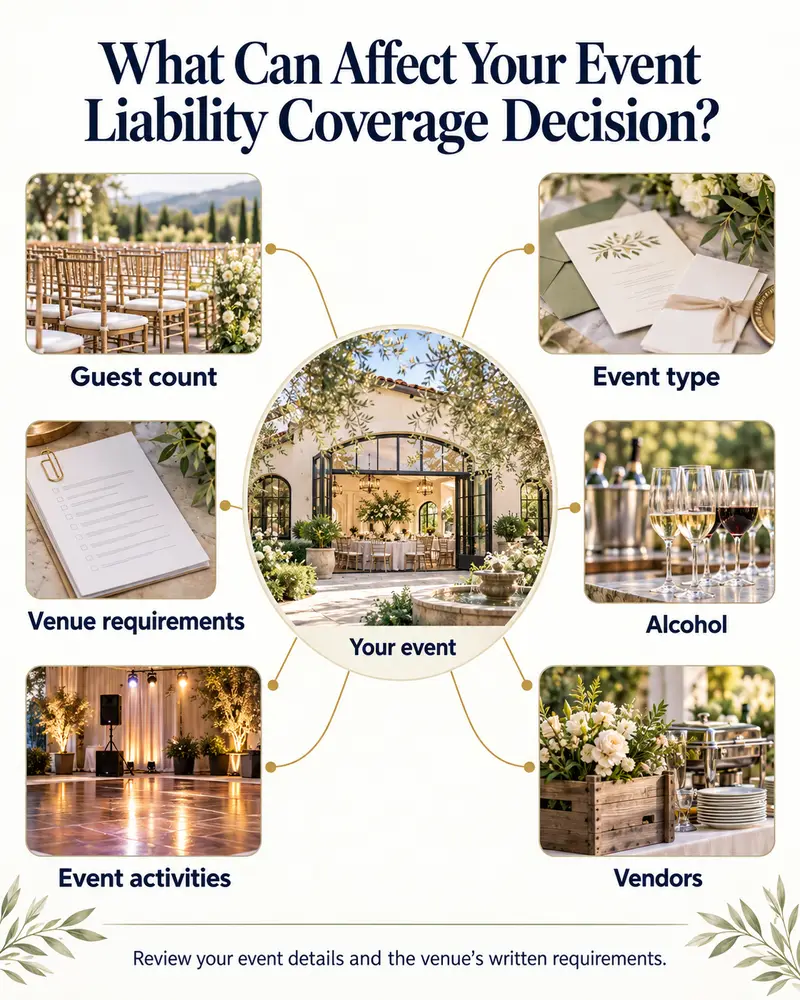
Your venue's requirement is the first major consideration, but several characteristics of your event can also matter when discussing coverage.
1. Number of Guests
A 30 person private celebration and a 300 person wedding reception do not present identical circumstances.More guests generally mean more people moving through the venue, using its facilities, interacting with vendors, and participating in event activities.Provide an accurate expected attendance when requesting a quote.
2. Type of Event
A wedding, anniversary dinner, birthday celebration, corporate gathering, fundraiser, and other special event may each have different characteristics.Tell your insurance professional exactly what type of event you are planning.
3. Venue Requirements
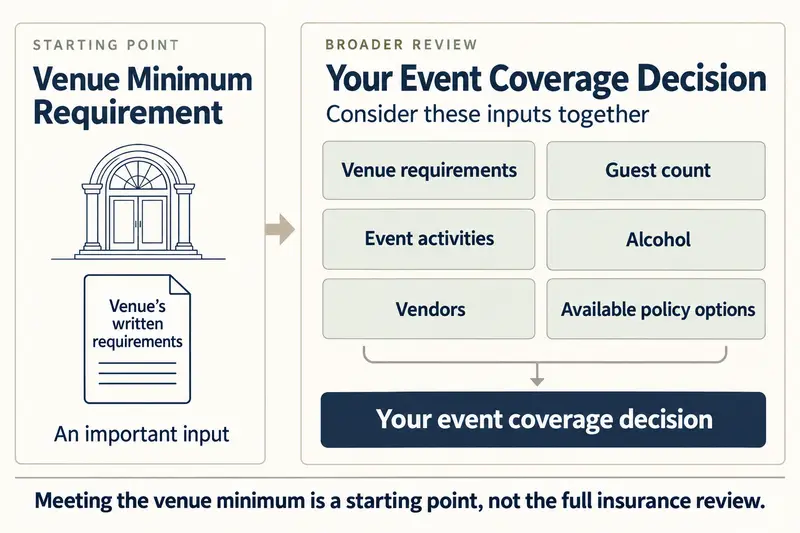
Your venue may establish minimum insurance requirements as part of the rental agreement. Meeting those requirements can be necessary for using the property.Remember, however, that satisfying a contractual minimum and evaluating your overall insurance needs are related but distinct questions.
4. Alcohol
Alcohol can introduce additional liability considerations. How alcohol is provided and served can matter when determining what insurance may be appropriate.Do not assume that every event policy handles alcohol exposure in the same way. If alcohol will be available, disclose that information when requesting coverage.Our guide “Does Event Insurance Cover Alcohol? Understanding Host Liquor Liability in California” addresses this issue separately.
5. Event Activities
Tell your insurance professional about activities that go beyond an ordinary dinner or reception.Certain activities may affect eligibility, underwriting, coverage, exclusions, or available options. Accurate information matters more than trying to make an event sound simpler than it actually is.
6. Vendors
Caterers, bartenders, rental companies, entertainers, photographers, and other vendors may participate in your event. Some venues require vendors to maintain their own insurance.Do not assume your personal event liability policy automatically substitutes for insurance the venue requires from a vendor.
7. Property and Equipment
Your event may involve venue property, rented furnishings, audiovisual equipment, decorations, or other items.Coverage for damage to property can vary substantially by policy and circumstance. If you are concerned about a particular type of property exposure, ask specifically how the policy addresses it.
Venue Minimum vs. Appropriate Coverage: Why the Difference Matters
Suppose your venue tells you that a certain amount of liability coverage is required. That establishes a contractual threshold you may need to satisfy.
But insurance planning should not become: “What is the least coverage I can buy and still get through the venue door?”
A better question is: “What does my venue require, what risks does my event create, and what coverage options are available to address those risks?”
Those questions produce a more useful insurance conversation.
The purpose of event insurance is not simply to generate a certificate. It is to provide protection under the terms of the policy when a covered loss occurs.
What Is an Event Insurance COI and Does It Show Your Limits?
Your venue may request a certificate of insurance (COI) after coverage has been arranged.
The COI provides evidence of insurance and generally summarizes certain policy information, including applicable coverage and limits. However, a certificate is not the insurance policy itself.
If you need a detailed explanation of the certificate process, read our guide to event insurance COI requirements in California. That article explains certificate holders, additional insured requirements, venue information, and common COI mistakes.
Does a Higher Liability Limit Mean Everything Is Covered?
No.
A higher dollar limit does not transform an excluded loss into a covered one. This distinction is extremely important.
Insurance protection depends on several elements, including:
- What coverage the policy provides
- Policy definitions
- Limits
- Conditions
- Endorsements
- Exclusions
- Facts surrounding a claim
Think of a limit as a boundary on available coverage, not a guarantee that every type of loss falls inside the policy.Always review the policy and ask questions when you are uncertain about a particular exposure.
Does Event Liability Insurance Cover Damage to the Venue?
Certain event liability policies may provide protection for covered property damage claims, but you should not assume every type of damage to a venue or rented property is covered.
Coverage depends on the policy and circumstances. For example, different rules may apply to property that you rent, occupy, use, possess, or control.
If your venue contract makes you responsible for particular types of damage, bring that language to your insurance professional and ask how the available policy responds.
What About Alcohol Liability?
If your event includes alcohol, discuss it before purchasing coverage.
There can be an important difference between situations involving a host providing alcohol and circumstances involving the business of selling, serving, or furnishing alcohol. Policy wording and the circumstances of the event matter.
Do not select a general liability limit and assume that it automatically resolves every alcohol related exposure.
For a detailed explanation, see our upcoming article on event insurance and host liquor liability in California.
Do Vendors Need Separate Liability Coverage?
They may.
Your venue may require vendors to provide their own certificates of insurance or satisfy separate liability requirements. For example, requirements could potentially apply to a:
- Caterer
- Bartending company
- Rental company
- Entertainment provider
- Production company
- Other contractor working at the event
Ask the venue which vendors must provide insurance and communicate the requirement before signing vendor agreements whenever possible.Your event policy should not automatically be treated as a replacement for a vendor's own insurance obligations.
What About Wedding Cancellation Coverage?
Liability insurance primarily addresses liability exposures. It should not automatically be confused with coverage designed for financial losses related to cancellation or other wedding expenses.
A wedding can involve substantial deposits and advance payments for the venue, catering, photography, entertainment, rentals, and other services.
Depending on the policy, separate wedding or event coverage options may address certain covered cancellation or vendor related losses.
If protecting event expenses is one of your goals, discuss that specifically when requesting wedding and event insurance.
How to Choose an Event Liability Limit: A Practical Process
Instead of starting with a random number, use a structured approach.
- 1 Get the venue requirements in writing. Ask for the full insurance requirements rather than only the minimum liability amount.
- 2 Review the event details. Know your expected guest count, event type, venue, vendors, activities, and whether alcohol will be present.
- 3 Share everything with your insurance professional. Provide the actual venue document whenever possible.
- 4 Review available coverage and limits. Ask what liability limits are available and how they apply under the policy.
- 5 Ask about important event specific exposures. If alcohol, unusual activities, valuable rented property, or other concerns are involved, raise them directly.
- 6 Arrange the required documentation. If your venue requires a COI or additional insured documentation, make sure those requirements are addressed where available and applicable.
- 7 Review the policy. Do not stop once the venue accepts the certificate. Review your policy documents so you understand the coverage you purchased.
Questions to Ask Before Buying Event Liability Insurance
A productive insurance conversation should go beyond “How much does it cost?” Consider asking:
- Does this policy satisfy the requirements my venue provided?
- What liability limits are available?
- How do the occurrence and aggregate limits work?
- Can my venue be added as an additional insured if required and available?
- Can I obtain the certificate of insurance my venue requests?
- How does the policy address alcohol exposure for my event?
- Are any of my planned activities excluded or restricted?
- What should I know about property damage coverage?
- Are there important exclusions I should review?
Those questions help you evaluate the coverage itself rather than purchasing solely on price.
Don't Buy Event Insurance Based Only on Price
Events can already be expensive, so looking for ways to control costs is understandable.
But the cheapest insurance option is not necessarily the right one if it does not satisfy the venue's requirements or address the exposures that matter to you.
Compare:
- Coverage
- Limits
- Important exclusions
- Venue compliance
- Additional insured options
- Available event specific protection
- Price
Insurance should fit the event, not simply the budget line.
A Quick Event Liability Coverage Checklist
Before purchasing coverage for your California wedding or special event, confirm:
- Your venue's minimum liability requirement
- Expected guest count
- Event type
- Event date and location
- Whether alcohol will be present
- Important event activities
- Vendor insurance requirements
- Whether additional insured status is required
- Whether a COI must be submitted
- Available liability limits
- Relevant exclusions and policy conditions
Keeping these details together can make the quoting and venue approval process more efficient.
Get Help Choosing Coverage for Your California Event
There is no universal event liability limit that fits every wedding, party, or special event. Your venue's requirements provide an important starting point. From there, consider your event details and review the available insurance options.
Online General Insurance is a California licensed independent insurance agency based in Tarzana and serving customers throughout California. OGI offers wedding and special event insurance options and can help customers review event coverage and certificate requirements.
Already have your venue contract or insurance instructions? Request a wedding and event insurance quote from Online General Insurance or call (818) 922-7225 to discuss your event and available coverage options.
Frequently Asked Questions About Event Liability Coverage
How much event liability coverage do I need?
There is no single limit appropriate for every event. Start with your venue's written minimum insurance requirements, then consider your event size, activities, alcohol exposure, and available coverage with an insurance professional.
Is $1 million in event liability insurance enough for a wedding?
It may satisfy the requirements of some situations, but no single amount should automatically be considered sufficient for every wedding. Check your venue contract and discuss your particular event with an insurance professional.
Does a California venue decide how much liability insurance I need?
A venue may establish a minimum liability limit as a condition of renting its property. That contractual requirement is an important starting point, but you may also want to consider the broader insurance needs of your event.
What is the difference between a per occurrence and aggregate limit?
Generally, a per occurrence limit applies to a covered occurrence, while an aggregate establishes a maximum for covered claims subject to the applicable policy terms. Review your particular policy because terminology and structure can vary.
Does event liability insurance cover guests who get injured?
It may respond to certain covered third party bodily injury claims, depending on the circumstances and policy. Coverage is subject to the policy's terms, conditions, exclusions, and limits.
Does event liability insurance cover venue property damage?
Certain covered property damage claims may be addressed, but coverage depends on the policy and circumstances. Do not assume every form of damage to rented or occupied property is covered.
Does my event insurance limit appear on the COI?
A certificate of insurance generally summarizes certain coverage and limit information. However, the COI is not the policy and does not alter the coverage provided by the policy.
Can my venue be added as an additional insured?
Depending on the policy and circumstances, additional insured status may be available. If your venue requires it, provide the exact requirement to your insurance professional.