
Small Business Insurance in Los Angeles: What Contractors and Retailers Actually Need
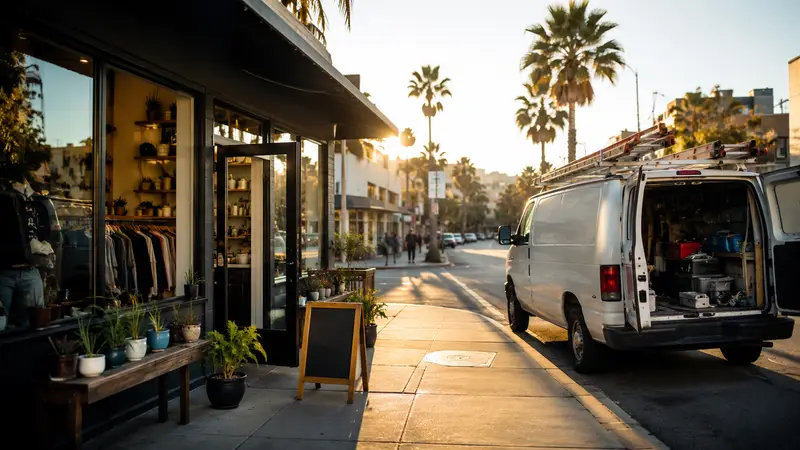
Los Angeles runs on small businesses. From the tile setter working a remodel in Tarzana to the boutique owner on Abbot Kinney, roughly 250,000 small businesses operate across LA County, and a large share of them are underinsured, over-insured in the wrong places, or holding a policy they have not read since the day they signed it.
This guide breaks down what coverage actually does, which risks are specific to operating in Los Angeles, and how contractors and retailers should think about bundling.
General Liability
General liability responds to third-party bodily injury and third-party property damage. A customer trips on a floor mat, your crew cracks a homeowner's marble countertop, a subcontractor's ladder puts a hole in a client's drywall.
It also covers personal and advertising injury (libel, slander, copyright infringement in your ads) and typically includes products-completed operations, which matters enormously for contractors because it is the coverage that responds when work you finished eighteen months ago causes damage today.
What it does not cover: your own tools, your own building, your own employees' injuries, or your own bad workmanship. Those are separate lines.
Most LA commercial leases require a minimum of $1M per occurrence and $2M aggregate. The California State License Board (CSLB) requires licensed contractors carrying certain classifications to maintain liability coverage, and public works projects almost always demand higher limits plus additional insured endorsements. Our general liability insurance page goes deeper on limits and endorsements.
Commercial Property
Commercial property covers what you own: the building if you own it, tenant improvements and betterments if you lease, plus inventory, furniture, fixtures, and equipment. Our commercial insurance page covers how these pieces fit together, and business owners in the west Valley can start with commercial property insurance in Tarzana.
Retailers need to consider how inventory valuation works. Actual cash value pays the lower depreciated amount, while replacement cost pays what it costs to replace the inventory today. For a shop carrying seasonal apparel or electronics, that difference is the entire claim.
Contractors need to understand that a standard commercial property policy generally does not follow tools off-site. That requires inland marine, specifically a contractor's equipment floater covering tools in transit, at job sites, and in vehicles.
Two exclusions matter in Los Angeles specifically: earthquake and flood are excluded from standard commercial property policies. Earthquake coverage typically requires a separate policy or endorsement, with deductibles generally running 10 to 20 percent of the insured value. Flood requires an NFIP policy or a private equivalent, relevant for businesses near the LA River corridor, in parts of Long Beach, and in Ventura County adjacent burn scar zones subject to debris flow.
Workers' Compensation
California is unambiguous here. Under Labor Code Section 3700, every employer with even one employee must carry workers' compensation. There is no small-employer exemption, no part-time exemption, and no "they're just helping out" exemption.
Penalties for going without: stop-work orders from the Division of Labor Standards Enforcement, fines up to $100,000, and personal liability for the injured worker's medical costs and lost wages. Criminal misdemeanor exposure exists for willful non-compliance.
Two points contractors get wrong constantly:
- Roofers (classification C-39) must carry workers' comp even with zero employees. This is a CSLB requirement, not a general rule.
- Uninsured subcontractors become your employees. If you hire a sub who does not carry workers' comp, their injured workers are treated as yours for both claim and premium purposes. Your auditor will charge you for their payroll. Collect certificates of insurance before work starts, not after the audit.
Rates depend on classification code and experience modification (X-Mod), assessed by the Workers' Compensation Insurance Rating Bureau of California (WCIRB). A roofing class code runs dramatically higher than a retail sales class code, and misclassification is one of the fastest ways to blow up a premium at audit.

LA-Specific Risk Factors
Operating in Los Angeles County adds exposures that a generic policy review will miss.
Permits and license compliance
Contractors working in the City of Los Angeles pull permits through LADBS (Los Angeles Department of Building and Safety). CSLB licensing requires a $25,000 contractor bond, and workers' comp certification must be on file with the board for applicable classifications. A lapse in workers' comp coverage triggers automatic license suspension, meaning you cannot legally pull permits or collect payment on open contracts. Public works, LAUSD work, and City contracts layer on more: higher liability limits, additional insured endorsements with primary and non-contributory wording, waivers of subrogation, and sometimes payment and performance bonds.
Foot traffic and premises liability
Retailers in dense corridors such as the Grove, Melrose, Third Street Promenade, Downtown's Fashion District, and Old Pasadena carry meaningfully higher slip and fall exposure simply as a function of volume. California's comparative negligence standard means a business can be found partially liable even when a customer was careless.
ADA exposure
California's Unruh Act permits damages of $4,000 per violation, and Los Angeles has been a focal point of serial ADA litigation. General liability policies typically exclude ADA claims, so Employment Practices Liability (EPLI) and specialized ADA defense endorsements are worth pricing.
Theft, vandalism, and catalytic converters
Retail theft and organized retail crime affect commercial property claims across LA County. Tool theft from job site trailers and work vans is a persistent contractor exposure, and catalytic converter theft has driven a wave of commercial auto claims, particularly for trades running trucks and cargo vans. Standard property policies include theft, but sublimits apply to money and securities, and off-premises property is limited. Contractors need equipment floaters. Retailers should review money and securities limits against actual daily cash handling.
Wildfire and Business Interruption
The Eaton and Palisades fires of January 2025 reset how many LA business owners think about catastrophic risk. Beyond direct fire damage, businesses experienced civil authority losses, meaning closure orders that prevented access to undamaged premises, and contingent business interruption when suppliers or anchor tenants were shut down. If your building sits in a high hazard zone, our breakdown of wildfire season in the San Fernando Valley explains how insurers are reassessing that exposure.
Business interruption is often the most under-purchased coverage in LA. It replaces net income and continuing business expenses during the restoration period. Most owners buy far too little, and many do not realize BI requires a covered direct physical loss to trigger, a lesson widely relearned during COVID-era litigation.
Extra expense coverage is the companion: costs to operate from a temporary location, expedite repairs, or lease replacement equipment.
Commercial Auto
If a vehicle is titled to the business, used for business, or carries tools and materials, personal auto will likely deny the claim. Contractors need commercial auto coverage with adequate limits, since California minimums are far below what a serious multi-vehicle accident on the 405 will cost. Hired and non-owned auto (HNOA) covers employees driving personal vehicles for business errands, an exposure retailers often overlook entirely.
The Business Owner's Policy (BOP)
A BOP combines general liability and commercial property, including business interruption, into a single policy. It is typically 10 to 20 percent cheaper than buying the lines separately.
BOP eligibility is driven by class of business, square footage, and annual receipts. Retailers are prime BOP candidates. Most contractors are not, since construction risk generally gets written on a package policy or on monoline general liability instead.
A Practical Contractor Stack
For most licensed trades operating in LA County, the program looks like this:
- General liability, with products-completed operations
- Workers' compensation
- Commercial auto
- Inland marine, a contractor's equipment floater
- Installation floater, for materials awaiting installation
- Umbrella or excess liability, often the cheapest limit you can buy and frequently required by contract
- Builder's risk, project-specific
- Contractor's license bond, $25,000 through the CSLB
A Practical Retailer Stack
For a storefront or boutique, the priorities shift:
- BOP, combining general liability, property, and business interruption
- Workers' compensation
- Commercial auto or HNOA
- EPLI, increasingly important given California's employment law landscape
- Cyber liability, if you process card payments, and you do
- Liquor liability, if applicable
- Crime coverage and employee dishonesty
Consolidating with one carrier typically produces package credits, a single audit process, and most valuably, it eliminates coverage gaps between policies. When a claim sits at the seam between two carriers, both tend to point at the other.
Getting It Right
The pattern we see most often in Los Angeles is not businesses with no insurance. It is businesses with the wrong insurance. A contractor with solid general liability but no equipment floater. A retailer with beautiful property limits and $10,000 of business interruption. An operation whose additional insured endorsement does not match what the contract actually requires.
The fix usually is not spending more. It is spending correctly. A proper coverage review looks at your contracts, your class codes, your loss runs, and your actual day-to-day operation, then rebuilds the program around what you are genuinely exposed to. Start with our business insurance services, or with local pages like business insurance in North Hollywood and Woodland Hills. Every community we serve is listed on our service areas page.
Contractor or Retailer in LA County?
A licensed California agent can review your class codes, contract requirements, and limits in one sitting. Get a quote, or look through our business insurance services first.
Frequently Asked Questions
Do I need workers' comp in California if I'm a sole proprietor with no employees?
Typically no. Sole proprietors with no employees are not required to carry it. Two major exceptions: roofing contractors (C-39) must carry it regardless, and most general contractors will refuse to let you on site without a certificate. Many sole proprietors buy a policy purely to win work.
Does general liability cover my tools?
No. General liability covers damage you cause to others. Your tools require inland marine, a contractor's equipment floater.
Is earthquake coverage included in commercial property?
No. It is excluded from standard policies and must be purchased separately, typically with a percentage deductible rather than a flat dollar amount.
What limits do LA landlords usually require?
Commonly $1M per occurrence and $2M aggregate, with the landlord named as additional insured. Larger centers and institutional landlords often require $2M and $4M plus an umbrella.
What happens if my workers' comp lapses?
CSLB suspends your license. You cannot legally perform work requiring a license, pull permits, or enforce payment on contracts. Reinstatement requires filing proof of new coverage, and the suspension period stays visible on your public license record.
Are 1099 subcontractors covered under my policy?
Not automatically, and California's AB 5 and ABC test make worker classification aggressive. If a sub cannot produce their own certificate of insurance, your auditor will treat their payroll as yours and charge premium accordingly.
Does my policy cover ADA lawsuits?
Usually not. General liability commonly excludes them. Given Unruh Act statutory damages of $4,000 per violation and heavy filing volume in LA, ask specifically about ADA defense endorsements or EPLI.
How do certificates of insurance actually work?
A COI shows proof of coverage. It is not the coverage itself. Being listed as a certificate holder does not protect a client, which requires an additional insured endorsement on the policy. Contractors get burned by this distinction constantly.
Can I get coverage with prior claims?
Yes, though pricing reflects loss history. Workers' comp X-Mod is calculated from a three-year window excluding the most recent year, so a bad year affects pricing for roughly four years total.